skip to main | skip to sidebar

Think with Google

  • Home
  • About

Tips, Tools & Insights for planning marketing campaigns


  • ideas 42
  • impact 29
  • implement 28
  • insight 83

Blog Archive

Subscribe to this blog

Labels

  • automotive 1
  • b2b 3
  • banking 1
  • business 8
  • consumer behaviour 39
  • creative agencies 1
  • creative gallery 10
  • ecommerce 6
  • English 201
  • events 9
  • finance 3
  • fmcg 4
  • fun 14
  • gambling 1
  • google maps 2
  • google news 1
  • google wave 1
  • home entertainment 3
  • how to guides 5
  • ideas 42
  • impact 29
  • implement 28
  • insight 83
  • internet access 3
  • local 6
  • marketing 6
  • media mix 2
  • mobile 8
  • on the street 9
  • planner's favourite 13
  • property 1
  • research 40
  • search 16
  • social networks 8
  • stats 12
  • technology 5
  • Think with Google Blog 201
  • tools 2
  • travel 10
  • welcome 1
  • youtube 44

Useful stuff from Google

  • Google Agency Tools
  • Google Insights for Search
  • Google Internet Stats

We Love Feedback

Want to share your thoughts on a post? Or have a suggestion for something to focus on?
Send us an email
.

Powered By Blogger

Showing posts with label impact. Show all posts

Baines & Ernst uses responsive web design, mobile conversions leap 51%

English ideas impact implement Think with Google Blog
Thursday, August 22, 2013

Baines & Ernst is a leading provider of debt solutions in the UK. In dealing in such a complex subject area, the company’s aim in terms of digital is to help users understand its products. And from all accounts, that’s something it seems to be doing better than ever, thanks to the launch of a new responsive web design (RWD) site. On mobiles, pages per visit have increased by 11%, average visit duration is up 30% and mobile bounce rate is down 8%. Most impressively though, mobile conversions are up by 51% since the RWD site’s debut.


When Baines & Ernst first grasped that mobile usage was on the rise, the decision was made to launch mobile-specific search advertising in late 2011, incorporating both sitelinks and click-to-call functionality. Positive results from this led Baines & Ernst to create a mobile-optimised site that launched in the second half of 2012.


While the additional site helped provide a better experience to growing numbers of mobile users, maintaining fresh content on both the desktop and mobile site proved to be an inefficient use of resource. Through testing and research, Baines & Ernst discovered a solution that would satisfy its goals. The main focus was to deliver a consistent user experience across all devices so potential customers could find the right information on any screen. The team initiated the build of an entirely new site incorporating the best practices of RWD.


Using RWD enabled Baines & Ernst to optimise its site experience across different screen sizes without creating multiple websites. By using flexible templates, CSS media queries and JavaScript events, the new RWD site responds to a user’s screen size and orientation, and then adjusts images, layouts and content visibility in accordance. It also harnesses novel device capabilities such as dragging, swiping and other gestures recognised by touch devices. All of this can be layered onto a single repository of HTML content, so while there’s only one content file to be maintained, it can be delivered across all devices.


Since most consumers lack deep familiarity with financial solutions, the company’s online presence is a critical tool for explaining Baines & Ernst products. As more and more consumers are researching these kinds of products away from their desktop computers, the move to an RWD site has proved a very savvy one. Read more of the Baines & Ernst RWD success story here.

Posted by Matt Brocklehurst, Product Marketing Manager, Google
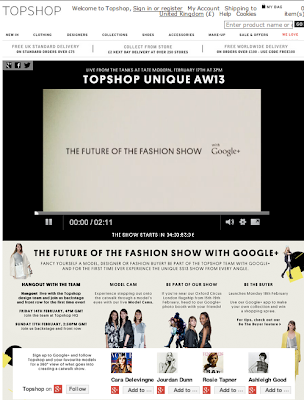
How Fashion gets a makeover with Topshop’s full London Fashion Week experience on Google+

English impact implement Think with Google Blog
Wednesday, March 20, 2013

There was a time when only editors of the world’s style bibles got the chance to sit on the front row of a fashion show, when the catwalk was the exclusive domain of top models, and when stylists and makeup artists were the only ones lucky enough to join in the backstage excitement of London Fashion Week.

But this February Topshop reinvented its fashion show and simultaneously democratised the thrill of London Fashion Week. How? By partnering with Google+ in a groundbreaking series of inventive online happenings. The programme not only grabbed headlines – a key goal of every brand’s fashion week involvement – but also stimulated deep engagement with the Topshop audience. The programme had four components – Be the Model, Be Part of the Team, Be the Front Row Fashionista and Be The Buyer.


Be The Model afforded a rare opportunity for fans to get a model’s-eye view of fashion week. Top models Cara Delevingne, Jourdan Dunn, Rosie Tapner and Ashleigh Good wore HD micro cameras – “model cams” – so online viewers could see and feel what models experience as they stride down the runway. And at Topshop’s Oxford Street flagship fans could enter a special Google+ booth and try on their favourite outfits. From the booth, an animated picture was instantly uploaded to the Topshop’s Be the Model Google+ event page.

Be Part of the Team included an exclusive hangout on air behind the scenes at Topshop’s headquarters with a host of fashion insiders, such as Kate Phelan (Topshop Creative Director), Emma Farrow (Topshop Head of Design), Hannah Murray (international make-up artist) and Beth Fenton (show stylist). Two lucky Topshop fans were allowed to post questions just before the start of the show.
Be the Front Row Fashionista featured a red carpet hangout on air on the day of the show and allowed viewers to get a unique perspective from the front row. After the arrival of leading celebrities like Kate Bosworth, One Direction star Louis Tomlinson and Pixie Geldolf, the hotly anticipated show was streamed on Topshop.com, in Topshop’s Oxford Circus store and on all of Google’s platforms through a special customised YouTube gadget.
Be The Buyer saw the launch of a hangout app that enabled users to pick and choose their favourite items to share with friends on Google+. Topshop chose the best fashion collection from among these and awarded one stylish winner a free shopping spree. The app was promoted on Topshop’s homepage through a leaderboard that dynamically ranked the most popular of all the shared items.
The programme delivered fantastic results:
  • 4 million views across all platforms
  • 2.5 million views from YouTube
  • G+ posts viewed over 400,000 times, a +400% increase
  • Comments increased by 340% per day
  • Reshares increased by 275% per day
  • +1s increased by over 400% per day
  • 7,500 live views of red carpet hangout
  • 600 animated photos posted from in-store booth
  • Average 11-minute engagement with hangout app, 52% reshares
  • 300,000 new G+ followers in two weeks
  • 2 million views from TrueView ads
  • 400+ press mentions (inc. Guardian, Vogue, CNN video, FastCompany, Vogue IT & FR)
To learn more about the future of fashion, read the full case study here. 

Post by Natalia Cano, Product Marketing Manager, Google+

Gumtree extend the reach of TV ads

English impact implement Think with Google Blog
Thursday, February 14, 2013

Gumtree a network of online classifieds and community websites, wanted to extend the reach of their TV advertising on YouTube using TrueView ads. To achieve this, Gumtree harnessed the power of Google data to get the right ads in front of the right searchers.

Using TrueView ads Gumtree achieved a 26% view rate (45% above the benchmark), whilst maintaining a low cost per view at 2p (75% below the benchmark). Gumtree were also able to attract new visitors to their website with 59% of visitors from YouTube new to Gumtree.

Sam Diamond, Head of Brand and Communications at Gumtree highlighted the importance of YouTube in their media strategy by saying 'We found TrueView easy to use, and an effective way of extending the reach of our TV advertising. We gained lots of interesting insight from our trial, and will now always consider YouTube as part of our media strategy'.

You can find the full Gumtree YouTube channel here.

For further details on YouTube TrueView ads click here or watch the short video below.
Posted by Ali Turhan, Industry Analyst - Agency Strategy

Ocado case study: Google+ features take the cake

English ideas impact implement Think with Google Blog
Wednesday, September 19, 2012


With its inherently digital focus, internet grocery retailer Ocado has established itself as an early adopter of new technologies, so it comes as no surprise that the company embraced Google+ as soon as it could – and has already started reaping some tasty benefits.

The opportunity for Google+ to contribute to improved search rankings was a convincing reason to launch the brand’s Google+ page. By adopting social extensions, Ocado ads became instantly more compelling, and click-through rates increased by 30%.


Hangouts are a clever way that Ocado has brought food-centric content to life. The company capitalised on its existing Great British Chefs initiative and used Google+ to produce a live event where the chefs cooked for customers. Ocado promoted the hangouts via True View ads on YouTube, which resulted in 167k engaged views. The Ocado YouTube channel views went from 50k to 230k in the space of a week thanks to the hangout, without including the people who live-streamed the event (which numbered about 60 individuals at any given time).


The experience has led Ocado to consider further possibilities for moving images. They are keen not to use text-based feeds as what they really want is to get people excited about food, and images are a great way of differentiating. In addition to hangouts and images, Ocado has embraced the Google+ badge which appears on the check-out page with the aim of making the shopping experience social through gifting and sharing.

In future, Ocado has plans for more hangouts on the Google+ page, as well as ideas for more video and channel-specific content. The intention is to deliver the sights and sounds – if not the tastes and aromas – of Ocado products straight to users’ screens.

Find out more about Ocado’s recipe for success by reading the full case study here.

Posted by +Natalia Cano

LateRooms.com personalises their brand through Google+

English ideas impact implement Think with Google Blog
Wednesday, May 30, 2012


LateRooms.com aims to be a truly global brand, matching customers around the planet with suitable hotel rooms. They measure their Google+ success through engagement – numbers of fans, interactions with users, how many times people share content and mention their brand.

Google+ matches LateRooms.com’s social media objectives
When the team launched a Google+ page, they quickly saw that – unlike some of the other social networking channels they use – followers were from all over the world, not just one or two isolated geographical regions. But instant worldwide scope wasn’t the only quick win; Google+ also provided a host of tools that help maintain the brand’s personal feel.

Hangouts and photos allow LateRooms.com to engage at a personal level with fans
The LateRooms.com +page features pictures of the members of the team, who also sign posts and messages by name. They’re using hangouts too, a feature unique to Google+ that offers high-quality video chat. By organising a hangout with renowned adventure expert Ray Mears, they effectively brought to life the idea LateRooms.com is not only a worldwide contender, but also one that you can also interact with on a one-to-one level.

Ripples help LateRooms.com identify brand influencers
Ripples are another distinctive component of Google+ and these help LateRooms.com identify brand influencers by showing how posts spread across the platform. LateRooms.com is approaching 600,000 followers on Google+, has had one post that has been shared over 2,500 times and another that’s been shared 2,000 times – and counting. Both of these garnered approximately 500 comments, the maximum allowed.

Next up: focusing on social extensions and circles
LateRooms.com focus areas include the use of circles, another feature unique to Google+, and expanding their use of social extensions. This feature is helping LateRooms.com obtain a higher number of brand recommendations, +1’s and direct traffic to their Google+ page. They’re benefiting from a 9% CTR uplift so far and have decided to enable social extensions on all their Adwords campaigns.

To learn how to replicate LateRooms.com’s success, read the full case study here.

Posted by Natalia Cano, PMM Google+ for Businesses

How Google+ has helped Cadbury connect with over 1.2 million people

English impact implement Think with Google Blog
Tuesday, May 22, 2012


Cadbury has become the European brand with the largest number of followers on Google+, currently at 1.2 million. Their Google+ success is having a strong impact on their overall marketing strategy, especially by improving the performance of their Search campaigns. The question is how exactly did they do this...?

Their first step was to create a Google+ page. As featured in a previous blog post, Cadbury used hangouts to interact in real time with Olympic athletes and chocolate experts, and to participate in creating the chocolate replica Google+ page. By promoting their hangouts, Cadbury grew their Google+ follower base by 150,000 people.

They also used circles to segment their followers according to their chocolate preferences and unveiled a brand-new product launch, the Dairy Milk Bubbly Bar, which has achieved a strong impact with sales already over £8M.

However, where they are seeing tremendous results is in their search campaigns. Since they started using social extensions, which links Cadbury’s Google+ page to its AdWords campaigns, they have achieved a 17% uplift in CTR across all their AdWords campaigns. Now when you search for “Cadbury” and see the relevant ad, recommendations from your friends are displayed directly with it, making the ad much more relevant to you. By clicking on the social extension, you directly land on Cadbury’s Google+ page and can start following all the great content they are posting.

And since Cadbury installed the Google+ badge on its homepage, it’s now easier than ever for fans to follow the brand; Cadbury gains 10,000 new followers on average per day and have had an increase of 7.5% in traffic from Google URLs.

To continue benefiting from their Google+ success, Cadbury are looking to include a Google+ social stream that will pull in their most recent updates into a re-launch of their homepage, which will be happening soon. Stay tuned to the Cadbury Google+ Page to learn how Cadbury continue to innovate to make their Google+ experience a success...!

Find out more about Cadbury’s http://www.blogger.com/img/blank.gifsuccess with Google+ by reading the full case study here.

Posted by Natalia Cano, PMM Google+ For Businesses

L'Oreal: Xmas Corridor Cross Media Research

English impact implement Think with Google Blog
Monday, January 16, 2012


L'Oreal Luxury Products launched a multi-media campaign during Christmas 2010 in UK, France, Italy and Spain. They covered a wide range of franchises including Armani, Diesel, Ralph Lauren, Yves Saint-Laurent, Cacharel and Lancome. The campaign ran on YouTube and TV in each country.

Research was conducted with MetrixLab to understand the impact of YouTube and TV in terms of incremental reach, effectiveness at raising awareness and impacting branding metrics and efficiency of both media.

The results show that YouTube is a fantastic platform to compliment your TV campaigns. Some key highlights include:

  • YouTube offers incremental reach: 15% average total reach (20% for Top 5 campaigns) and 3% average incremental reach (5% for Top 5).
  • YouTube reaches lighter TV viewers. 77% of YouTube exposed had lower average contacts with TV.
  • YouTube can be used as a lever to optimize TV budgets: Shifting 40k€ TV budget to YouTube results in +2 to 3% incremental YouTube reach.
Please download the full research here.

Posted by Rosie Rankin, Agency Team

Google Firestarters #3: The OS of the future for agencies?

English ideas impact insight Think with Google Blog
Wednesday, September 28, 2011

At Google UK we wouldn't presume to know the answer to this question. So for our third Firestarters event in our London office we invited three points of view from Mel Exon of BBH Labs, Martin Bailie of Glue Isobar and James Caig of MEC. In theory, this means we had points of view from an advertising agency, a digital agency and a media agency, although as we've found at previous Firestarters, the discussion rather undermines any neat division between agency types. The event was hosted by Andy Griffin from Google UK’s Agency Team and curated as usual by the Neil Perkin of Only Dead Fish.

The three providing 'provocation' agreed that the question raises two big and different issues: the organisation and the output; what you do and how you do it. And they also agreed on the importance of culture and people to shape 'how' you do things and improve the 'what' that your agency produces.

Mel Exon offered a challenge and some hope. It's no longer possible for marketers to buy their way into people's attention. They have to provide something properly useful, or properly entertaining, or just ‘epic’ to avoid ending up unseen and unheard, she argued. Yet the opportunities offered by the pace of change in technology make this the most exciting time ever to be working in marketing. She urged agencies to foster 'renaissance (wo)men' - people who assume whatever they can come up with will, through developing technology, be possible, rather than limiting their ambitions. She put it bluntly: marketing should become so entertaining or useful that it becomes indistinguishable from the product or platform it promotes.

Martin Bailie had a different take - more challenging to the status quo of agencies but arguably also more risky. He suggested there was an opportunities for marketing agencies to diversify and start selling ideas and digital products directly to the end consumer. Building on Mel's idea of providing something useful or entertaining, but also turning this into its own revenue stream for the agency. He argued that this would improve an agency's skills, business understanding, credibility, and also help keep staff empowered and interested.

MEC's James Caig told us that the diversification of revenue streams was already a feature of life for his agency. He looked to Simon Waldman's Creative Disruption for some suggestions for how to go forward from here: transform the core business, look for adjacent opportunities and innovate at the edges of your capabilities. For him, digital is already pushing the transformation of the core business of media agencies and most agencies on a roster are looking at adjacent opportunities, so the interesting area is innovating at the edges. He suggested agencies make a business out of their ability to spot creative talent and nurture it, or use the analytics skills within agencies to provide data using a freemium model.  Again he came back to the importance of people - the operators of any new OS - and how to empower them, equip them and trust them to deliver future business strategies and creative solutions.

So if that's the 'what' the future operating system of agencies will provide, what did our challengers think of the 'how' this will work?

Mel suggested that a planner's inclination to aim for single minded communication meant the idea of a 'minimum viable product' should sit naturally. Paring down your offering to the bare minimum that can work is a core way of working for tech startups, so shouldn't agencies work like this, she argued? She thought nimble, task-based teams, assembled based on the client's needs rather than a traditional departmental structure, could deliver better solutions. James agreed that organising by skill set not department was the way forward, with teams focused but connected into the rest of the agency through strong communication. He wanted to foster 'entrepreneurial opportunities' - giving teams the power and support to deliver on new business ideas. Martin Bailie took this one step further, suggesting that while agency groups will consult on how to deliver the best outcomes for their client, creatively led agencies should focus on their own outputs - be that a client campaign or a product aimed straight at end consumers.

We hosted a noisy discussion among the guests following the speakers' provocation. Perhaps after all an agency's role is purely to add value through branding, creating demand for the product or service being marketed, rather than getting involved in any new product development? The debate will rumble on and I'm sure the subject for the next Firestarters event will fall out of the heat of the discussion...


Posted by Gerald Breatnach, Agency Team

Bringing campaign ideas to life - Listerine YouTube Case Study

English fmcg ideas impact Think with Google Blog
Tuesday, September 20, 2011

In Listerine's Mouth vs. Life campaign, their key objectives were to transform consumer perceptions of the brand and to connect with people in a way that was fun, disruptive and engaging.

Essentially, they wanted to bring their brand idea of 'what you put your mouth through' to life in an extremely visual way, with a touch of comedy.

YouTube provided an ideal platform for the campaign given its reach and the scope for interactivity and engagement. Using a strategic combination of mastheads, true view ads and promoted video alongside their YouTube channel, Listerine embarked upon satisfying their initial objectives.


Their YouTube channel invited visitors to watch visual representations of what they put their mouths through based on what the average mouth might come in to regular contact with, from drinks to cakes, and even pens!

Listerine's YouTube channel received no less than 2.5 million views with a dwell time of 1 minute and 2 seconds. They also received 55 million impressions across their mastheads.

For more details of how they developed the idea for this campaign and for the results, please watch the short video here.


Posted by Selina Rennie, Agency Team

AdMob campaign drives unprecedented user engagement for Unilever

English impact mobile Think with Google Blog
Thursday, June 23, 2011

Cross-post from the Google Mobile Ads blog

When Unilever launched it’s new Lynx Excite product, they commissioned simple but powerful advertising creative. The video ads promoted a fragrance so irresistible it causes angels to fall from the sky. Unilever knew from the start that they wanted the film to work across a variety of formats, reaching not just TV viewers but also cinema visitors and mobile users.

For the mobile component of the Lynx Excite campaign, they were immediately drawn to the AdMob platform. AdMob enables advertisers to engage with mobile users across mobile platforms to maximize reach with their target audience.


In order to provide the most engaging experience possible for mobile users, Unilever built a robust HTML5 mobile landing page for the campaign. Mobile banner ads led users to an extended advertising experience, where a rotating halo enabled navigation through the microsite. A visitor could view the television ad, see exclusive behind-the-scenes footage and enjoy interactive features including tips, tricks and tools.

Through AdMob, the ads achieved results that far surpassed expectations. In all, 149 million impressions were served and 690,000 unique visitors accessed the content. On all devices, users spent approximately two minutes actively engaging with the Lynx brand storytelling. In terms of this phenomenal reach and high levels of engagement, the mobile advertising achieved unprecedented results for Unilever.


Posted by Vicky Homan, Google Mobile Ads Marketing Team

New reach & frequency study with Ubisoft

English impact research Think with Google Blog youtube
Friday, April 15, 2011

We are pleased to announce the release of our first multi-country reach and frequency study, with Ubisoft.

For the launch of their video game, "Michael Jackson: The Experience", Ubisoft ran a multi-media campaign in the UK, France and Germany.

The research conducted with GfK and MarketingScan, seeks to understand the overall impact of each media and YouTube formats in the mix-media in terms of reach and frequency. It also examines the incremental impact of YouTube in terms of reach, frequency and profiles.


Key findings from the study:

  • YouTube can drive incremental reach for your campaign.
  • The YouTube Masthead maximises incremental reach of YouTube, especially among core target groups aged 16-34.
  • YouTube can optimise cost-efficiency of cross-media campaigns.
  • A longer YouTube schedule - achievable with alternative formats (ROS, Pre-roll) - will help maximise reach potential of YouTube over four weeks and allow a greater cost-efficiency.

To learn more, please download the full study here.


Posted by Selina Rennie, Agency Team

Media ROI study with AXA

English finance impact research Think with Google Blog
Wednesday, March 2, 2011

We are pleased to share our new case study with AXA brand, Direct Seguros, which was recently conducted in Spain. The study demonstrates the role of search in driving both online and offline applications, and the cost efficiency of search relative to other media. A recommendation for optimal media mix is also included as part of the paper.


Highlights from the study:
  • Significant online to offline effect. 8.8% of offline conversions are driven by online activity.
  • Paid search is the most cost-effective way to increase insurance applications - over ten times more efficient than other media.
  • Improving position in paid search increases applications online by 2.7%, and offline via the call centre by 1.7%.
  • Considerable TV and search synergy – TV incrementally drives 6% of paid search clicks.

If you would like to learn more about this new piece of research, please download it here.


Posted by Selina Rennie, Agency Team

L’Oréal Nutrigloss Online to Store Study

English impact research Think with Google Blog youtube
Tuesday, February 22, 2011

Here we share our recently released case study with Nutrigloss conducted in France. The study shows the incremental impact of a YouTube campaign on the offline sales of Nutrigloss shampoo.


Key findings are as follows:

  • L’Oréal’s media spend became more efficient by using YouTube. Swapping some TV for YouTube achieved equivalent sales for 13% less budget.
  • Adding a YouTube campaign after a TV burst helped to maintain sales up to 17% above their post-TV level.
  • Up to 35% of those exposed to the YouTube & display campaign were not reached by TV.
  • The YouTube & display campaign was very effective in complementing TV, over-exposing those least exposed to the TV campaign.

To learn more, please donwload the full study here.


Posted by Selina Rennie, Agency Team

YouTube ad effectiveness study with Adidas

English impact research Think with Google Blog youtube
Thursday, January 6, 2011

We are pleased to share our recently released advertising effectiveness study conducted by Metrix Lab in the UK and Spain with Adidas.

This study sought to understand how the YouTube Masthead shifted key brand metrics for Adidas during their World Cup campaign.


Key findings from the study:

  • The Adidas masthead on YouTube had strong cut-through and extremely high levels of recognition with close to two thirds of exposed respondents, in both the UK and Spain, recognising the campaign.
  • Adidas’ top of mind association with the World Cup was lifted by 13% and 10% in the UK and Spain, respectively.
  • The Adidas masthead on YouTube drove positive brand image association in both markets.
  • Those exposed to the campaign in the UK conducted 93% more searches on the World Cup and Adidas than those who did not see the campaign.

To view the results in more detail, please download the full study here.


Posted by Selina Rennie, Agency Team

First study from the UK Media Efficiency Panel: Cadbury

English impact research Think with Google Blog
Thursday, December 16, 2010

We are very pleased to share the first cross media case study from the UK Media Efficiency Panel - the only single source panel which can link offline sales to online and offline media exposure.

The study sought to examine the cross media effectiveness of the Cadbury’s Chocolate Charmer Campaign and impact on short term sales. It also explores metrics such as cross media campaign reach, incremental reach, resultant uplift in sales and return on campaign investment.


Key highlights from the study:

  • The online element of the campaign provided impressive incremental reach. In particular, the YouTube campaign (Masthead + Promoted Video) delivered nearly 16% incremental reach over TV.
  • Amongst 15-34 year olds, the results were even better. Against this audience, online delivered 33% incremental reach.
  • Online drives in-store sales efficiently. The online campaign drove 20% of the in-store sales from just 7% of the budget.
  • YouTube Promoted Videos achieved an ROI six times higher than TV.

To learn more, please download the study here.


Posted by Selina Rennie, Agency Team

New GfK ROPO study with Vodafone

English impact research Think with Google Blog
Wednesday, October 20, 2010

This study takes a detailed look into the role of the internet in the decision process for mobile and broadband contracts, using the Media Efficiency Panel in Germany.


Key findings from this study:

  • The online research process of consumers who sign the contract offline is very similar to consumers who convert online.
  • Search engines are among the leading websites within the decision process for telecommunication products.
  • Generic search terms dominate the research process for both mobile and broadband contracts.

To learn more, please download the full study here.


Posted by Selina Rennie, Agency Team

YouTube Promoted Videos Research Study

English impact research Think with Google Blog youtube
Thursday, September 30, 2010

We're pleased to announce the release of our new branding research study conducted with Decipher on the promoted videos ad format on You Tube.

This research helps us to understand whether a promoted video impression has cut-through, either with or without a click and how it impacts brand metrics.


Key highlights from this report:

  • YouTube users are engaged and actively looking for information on products and brands
    67% of respondents claim to look for more information on a brand after viewing an ad on YouTube.
  • Promoted video impressions stand out
    Ad recall from an impression is high: 23% on the search page and 43% on the watch page.
  • All brand metrics were impacted by impressions alone
    - Unaided brand awareness increased by 3 times
    - Brand favourability increased by up to 44%
    - Purchase intent increased by 34%
  • Users like the Promote Your Video format
    They find it helpful and say they click because the thumbnail catches their attention.
To learn more, please download the study here.


Posted by Selina Rennie, Agency Team

YouTube campaign effectiveness study - Sony PlayStation

English impact research Think with Google Blog youtube
Monday, September 20, 2010

Here we share our latest YouTube campaign effectiveness study conducted by MetrixLab with Sony PlayStation and OMD for the Spanish market.

The aim of this study was to quantify the effectiveness and cost efficiency of YouTube and other media within the mix.


Key findings from this study:

  • YouTube delivers significant incremental net reach over all media.
  • The cost per percentage point reached on YouTube is one third cheaper than TV.
  • YouTube has a significant effect on key brand measures such as brand consideration, brand preference and purchase intent.
  • In combination, YouTube and TV are significantly more cost effective than TV alone.

The full study is available for download here.


Posted by Selina Rennie, Agency Team

PC City Online to Store Study

English impact research Think with Google Blog
Thursday, September 2, 2010

We are pleased to share our latest ROPO study conducted by MarketShare Partners with DSGi group - PC City in Spain. This study highlights the impact of search advertising in delivering an offline sales effect.


Here are some of the key highlights:

  • 16% of PC City's business is driven by the web.
  • Each euro invested in paid search delivers €27.48 in revenue offline and €4.68 online.
  • By shifting the media mix, PC City could increase total revenue by 6% with the same media expenditure.
  • By changing average page position of paid search, online sales would increase by 2% and offline sales by 9%
To learn more, please download the full study here.

Posted by Selina Rennie, Agency Team

YouTube: A breath of fresh air for Orabrush

English impact marketing Think with Google Blog youtube
Thursday, July 1, 2010

Here we share a truly inspiring story showing how Dr. Bob Wagstaff built his business by just advertising on YouTube.

Dr. Bob, the inventor of the Orabrush, tried somewhat unsuccessfully, to bring Orabrush to the market. He faced a string of rejections from various retailers and the $40k that he spent on an infomercial amounted to no more than 100 orders.

Following some market research carried out by university students, it emerged that a market for the Orabrush existed online. It was then that Dr. Bob decided to put together a YouTube video which has attracted over 12 million views and an enormous 19 million channel views to date.


This YouTube video, which only cost a few hundred dollars to create, attracted the attention of major distributors and retailers who were previously reluctant to buy into his idea.

From its invention in Dr. Bob's basement workshop to retailers around the world, the success of the Orabrush was only possible when a few people believed in it, and YouTube opened the way.


Posted by Selina Rennie, Agency Team

Older Posts Home

Subscribe to: Posts (Atom)

©2011 Google Think with Google About blog Terms of Service Privacy